The finance function you never hired.
Vault watches the money the way a CFO would. Every obligation registered, reserves held for payroll and tax, a runway floor you set, a plan that is funded before it is discretionary, and a forecast that shows when the pressure arrives. It tells you what changed, then answers the questions you lose sleep over: what to pay off first, when you can hire, whether the second office is affordable.
Nobody is holding the reserves
The tax bill, the runway, the payroll buffer. Everyone agrees they matter and nobody subtracts them before the balance gets spent.
Costs creep in silence
A vendor adds 8% at renewal. Twelve of those a year is real money, and each one individually is too small to notice.
Absence has no notification
A debit that failed, an invoice never chased, a contract that auto-renewed at a worse rate. Nothing tells you what didn’t happen.
The reserve stack
A CFO would never hand you the balance.
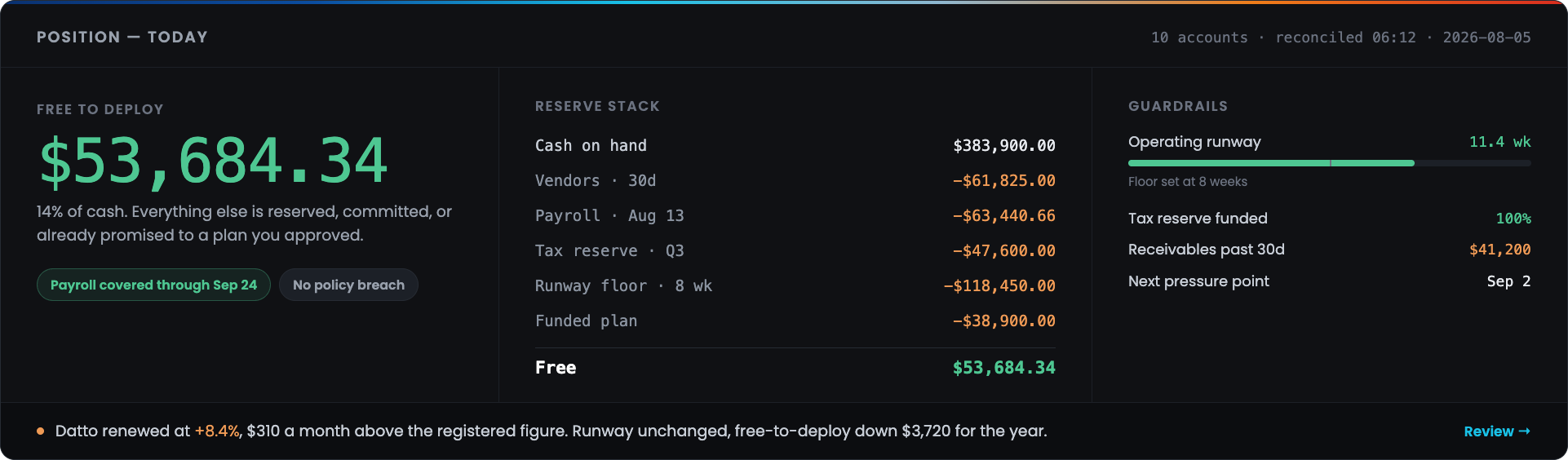
What is left after payroll and vendors is not yours. The tax bill is coming, the runway has a floor you set, and the plan you already approved has to be paid for. Vault takes all of it off before it names a number.
 four accounts $383,900.00
Fourteen percent of the balance. The other 86% has a name, a date, and a reason.
Reserves are policy, not mood
You set the rules once: weeks of runway, the tax percentage, how far ahead payroll is held. Vault applies them every morning and shows the arithmetic.
A decision is a commitment
The hire you approved and the refresh you scheduled are spoken for the moment you decide, not the moment the invoice lands.
The reserves absorb the shock
A client pays sixty days late and free-to-deploy falls first. Payroll and tax are the last things touched, and you hear about it the morning it changes.
The morning queue
It flags what it needs from you.
One message a day, in working hours, only when something changed. These are the five kinds of thing it interrupts you for.
Hollis Identity Group ends in 27 days. Renew, renegotiate, or cancel, prompted while all three are still possible.
Thornbury Cloud cleared at $2,666.29 against a registered $2,449.00. Old and new figures, side by side.
Meridian Fax Services debited $412.00 on Aug 2 — cancelled Jul 31. The evidence for the dispute is the alert itself.
Calderwood Monitoring’s expected debit never cleared. Either you saved money or something is broken. Both are worth knowing.
Payroll on Aug 13 needs $63,440.66 and it is reserved. If a payroll run is ever at risk, that alert outranks everything on this page.
The registry
Every obligation, checked against the bank.
Every recurring obligation lives here with its amount, cadence, tier and contract end date. Each expected debit is checked against what actually cleared the bank, so a row is either matched, missing, or drifted. The registry is what turns a balance into free cash.
Grow, save, pay down
Then it helps you make the long calls.
Payoff order, hiring, the second office, what the business would need to look like to sell. Answered from the numbers it already watches, never from a guess.
Pay off in the right order
Equipment Card first, at 22.9%. Then the line of credit.
Avalanche ordering across every card and loan, with what each payoff frees up monthly and what that does to the safe number.
Hire when it holds
Two engineers raise payroll to $71.2k a run.
The offer letters become registered commitments before they’re signed, so you see the new floor across all sixteen weeks first.
The second office
$14.2k a month committed from day one.
Lease, fit-out and staffing modeled as commitments against the forecast, so you see the go-or-wait decision before signing anything.
“Can I spend $8,000?”
Today’s decisions get a yes or no with the reason. Built to be read at arm’s length, standing in a supplier’s warehouse.

Ask the CFO
The long questions, answered from live numbers. It can act: register a commitment, end one, confirm a balance. Every action lands in an audit log.
Earned honesty
A tool that overstates its own certainty is worse than a spreadsheet, because you trust it. Vault shows a confident number and its own margin of error.
The five things everyone asks
My accountant does this.
An accountant closes last month. This answers today.
Another dashboard I won’t open.
It comes to you: one message a day, in working hours, only when something changed.
Connecting my bank makes me nervous.
The bank connection is read-only, through Plaid. Vault never touches credentials and cannot move money.
Setup will take a weekend.
It works from the first account connected and tells you how complete its picture is as you go.
We’re too small.
Then setup is an afternoon, and the picture is complete sooner. Vault works from the first account connected.
Reads from what you already run: QuickBooks Online, Plaid bank feeds, HaloPSA, Gusto.
What should this money do next?
Spend it, save it, pay something off, or make the big move, decided with real numbers. Vault is in beta with MSPs now.